


Have you ever watched Band of Brothers? It’s the kind of series that stays with you. I recently watched All the Light We Cannot See as well—one of those stories that will always be better as a book, but still watchable on screen.
In both, what struck me most was how making a garden under such conditions becomes something far more consequential than cultivating beauty, food, or even stress relief. Gardening, in these moments, reads as an anchor to normalcy. A reminder that planting a seed and tending it can still work—even with bombs falling, under occupation, or in foreign and hostile places.
That idea brought me back to the stories of prisoner-of-war gardens, and in particular, to the account of Captain John L. Creech, who gardened to keep himself and his fellow prisoners alive in a German prison camp in occupied Poland during World War II.
I gardened for my Life – the Gardens of POWs (Prisoners of War)
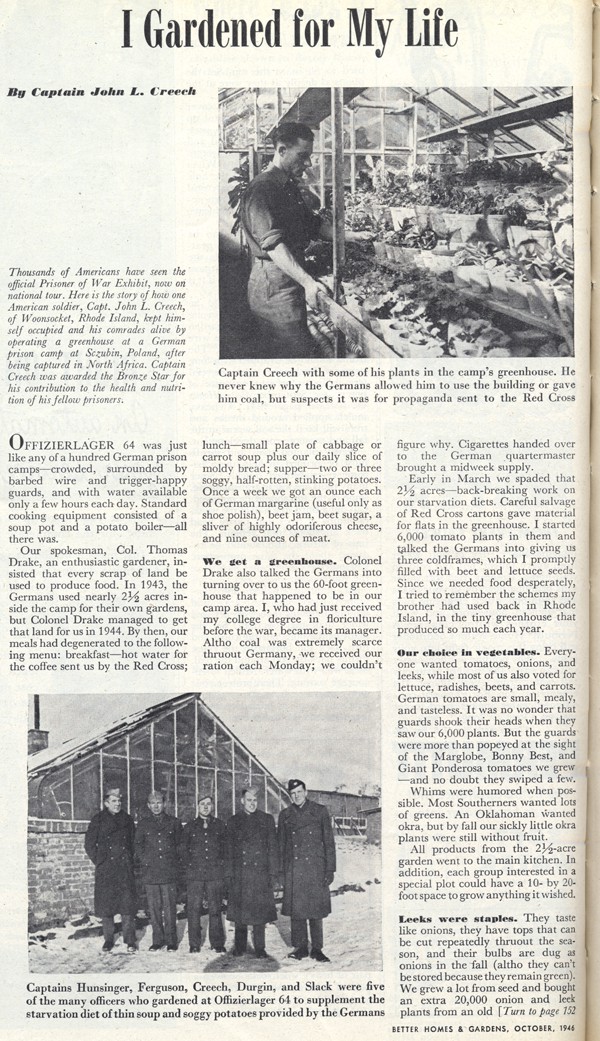
“The guards were more than popeyed at the sight of Marglobes, Bonny Best, and Giant Ponderosa tomatoes.”
American POWs recalled what they knew from growing plants back home—Rhode Island gardens, familiar varieties—and applied that knowledge to a crop of more than 6,000 tomato plants, along with countless vegetables and flowers. Seeds came from the American Red Cross, the Royal Horticultural Society, and from quietly salvaging plants during brief, supervised walks granted to doctors in the camp.
I’ve retyped the opening paragraph of the original article, published in Better Homes and Gardens in October 1944, because it bears repeating:
Thousands of Americans have seen the Prisoner of War Exhibit now on national tour. Here is the story of how one American soldier, Capt. John L. Creech of Woonsocket, Rhode Island, kept himself occupied and his comrades alive by operating a greenhouse at a German prison camp at Szubin, Poland, after being captured in North Africa. Capt. Creech was awarded a Bronze Star for his contribution to the health and nutrition of his fellow prisoners.
—Better Homes and Gardens, October 1944
I encountered this story through landscape historian Kenneth Helphand’s work on Defiant Gardens,, a project I first learned about through the Therapeutic Landscapes Network. Helphand’s research documents gardens created under extreme conditions—not as escapism, but as acts of survival, agency, and refusal.
He describes defiant gardens this way:
Defiant gardens are gardens created in extreme or difficult environmental, social, political, economic, or cultural conditions. These gardens represent adaptation to challenging circumstances, but they can also be viewed as sites of assertion and affirmation.

Works of Kenneth Helphand
You can buy Defiant Gardens: Making Gardens in Wartime here
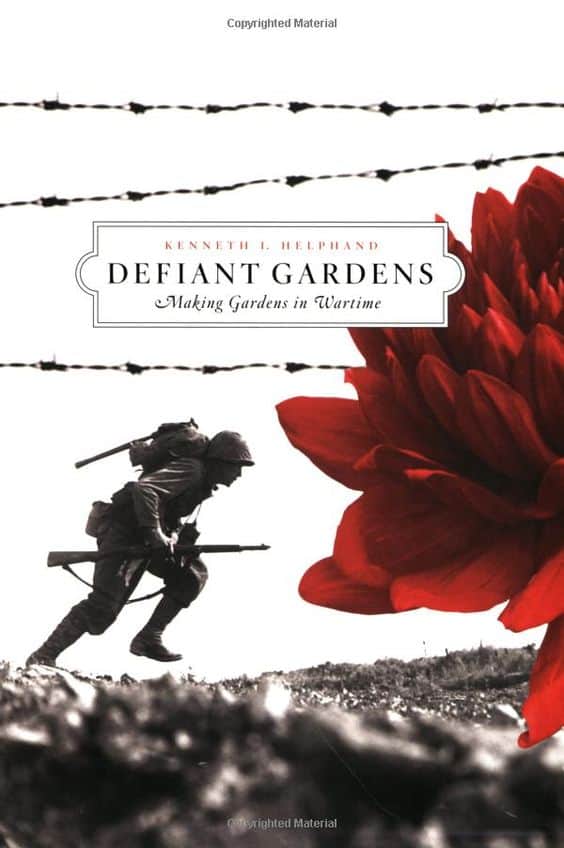
His work includes:
- gardens built behind the lines during World War I
- gardens created in ghettos under Nazi occupation
- gardens made by prisoners of war and civilian internees
- gardens constructed by Japanese American internees in U.S. internment camps
What stays with me is how clear the purpose of these gardens was. They were not decorative. They were not aspirational. They were practical, psychological, and deeply human. They asserted continuity where everything else had been disrupted.
Gardening, in these contexts, becomes an act of defiance. A declaration that life will continue, that care still matters, that tending something living is a way of refusing erasure.
That’s a very different frame from how we usually talk about gardens. And it’s one worth holding onto.
You can buy Defiant Gardens: Making Gardens in Wartime here
I was lucky to go to a lecture by Kenneth Helphand a few years ago — his presentation was really really interesting. And Defiant Gardens is an amazing book. So many great stories and examples of perseverance in unbelievably difficult situations. I definitely recommend it, too!