


People often ask if I meant to say piss and vinegar. Or maybe piss and vigor. Or some half-remembered version of a phrase they can’t quite place.
No. I meant PITH + VIGOR.
When I named the original print publication that eventually became this platform, I was collecting words the way gardeners collect seed. I carried a folded, increasingly illegible list in my pocket for weeks, adding to it whenever something landed. The words were botanical or adjacent, but more importantly, they carried double meanings. They felt sturdy. Historical. Alive.
At some point, I realized I wanted the name to be structured as something and something. I started pairing words from the list, testing how they sounded together and what they implied. That’s how the title emerged.
PITH + VIGOR began as a printed newspaper, published and mailed to subscribers from 2014 to 2016. Today, it exists as a digital platform, but the underlying idea hasn’t changed.
So what is pith and vigor?
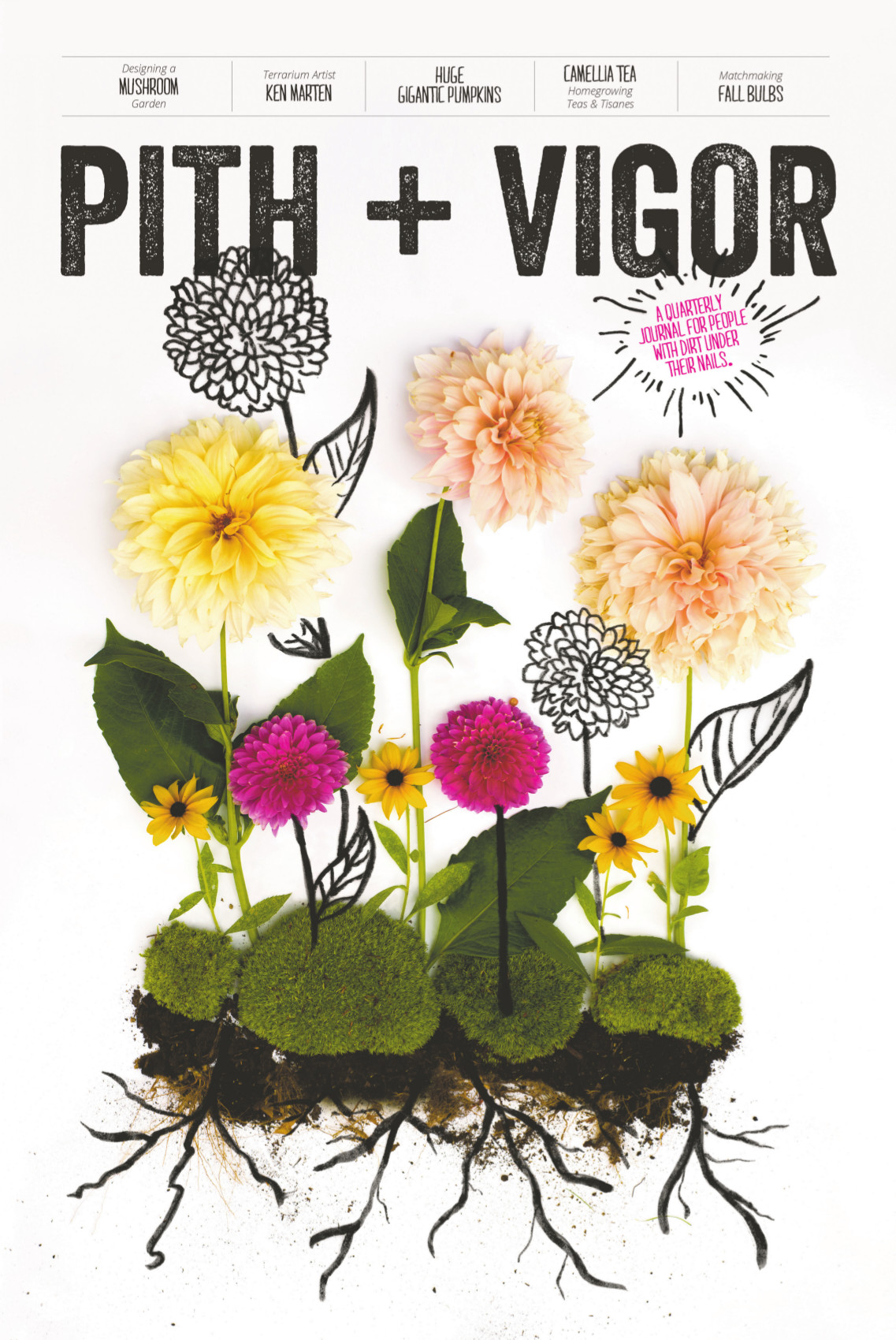
Metaphorically, the pith of a plant is its center. The core. The essential structure that allows everything else to function. Vigor, meanwhile, is energy and momentum. It’s a word that’s hard to say without feeling it.
What surprised me, and ultimately sealed the name, was discovering that pith and vigor once appeared together as a common phrase in the 1700s. It’s widely considered the linguistic root of what later became piss and vinegar.
The meanings, however, diverged.
In horticultural terms, the pith is the central cylinder of a stem. It’s a source of strength and vitality. You cannot logically have vigor without pith. Energy without structure collapses. Motion without a center becomes recklessness.
When I learned that pith and vigor were once commonly used together—way back in the 1700s—it felt like a small, perfect discovery.
The phrase is generally thought to be the etymological root of what eventually became piss and vinegar. And you can feel the relationship there. The later version is all spark and swagger. A little sharp. A little unruly. A firecracker.
But pith and vigor meant something slightly different.
The pith is the central cylinder of a plant stem. It’s the core. The part that holds everything together and keeps the whole thing alive. Vigor is the outward energy—the push, the force, the confidence.
The implication was that you couldn’t really have one without the other.
Vigor without pith would be all bravado. Bluster without substance. Something animated but not quite real. A performance of strength rather than the thing itself. And pith without vigor would be inert. Technically sound, but lifeless.
Together, though, they describe something fully alive. Strong at the center. Spirited on the outside. Capable of persistence, mischief, and momentum, but grounded enough to endure.
So what does PITH + VIGOR mean to me, and maybe to you?
It’s that unmistakable quality I see in gardeners I admire. A can-do confidence that’s earned, not postured. Hands in the soil, eyes wide open. A willingness to try things, to experiment, to pay attention, to adjust. To fail, learn, and try again.
It’s grit and grace. Curiosity. Energy with a backbone. Beauty that isn’t precious.
It’s believing that being part of something living—something spirited, stubborn, and imperfect—is worth committing to.
Welcome.
—Rochelle
+comments+